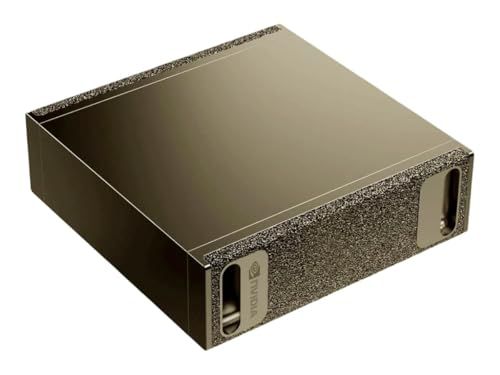
TLDR Review: NVIDIA GeForce RTX Founders Edition
Verdict
The NVIDIA GX Spark is a specialized local AI development box, not a tiny H100. Its 128GB unified memory, CUDA ecosystem, quiet operation, and compact design are compelling for developers running models too large for conventional GPUs. However, bandwidth-limited decoding, early stability issues, and high pricing make it poor value for maximum throughput. Buy it when model capacity, privacy, and CUDA compatibility matter more than raw speed; otherwise, a faster discrete-GPU workstation may be the better investment.
- Top pro:
- 128GB of coherent unified memory can run models up to roughly 200 billion parameters locally and fine-tune models around 70 billion.
- Top con:
- Approximately 273GB/s of memory bandwidth limits large-model token generation compared with systems using an RTX 5090, RTX Pro 6000, H100, Apple M3 Ultra, or multiple GPUs.
Pros
- •128GB of coherent unified memory can run models up to roughly 200 billion parameters locally and fine-tune models around 70 billion.
- •Broad CUDA compatibility and support for Docker GPU passthrough, Ollama, PyTorch, TensorRT-LLM, CUDA 13.0.2, RAG tools, and NVIDIA’s software ecosystem.
- •Strong prompt-processing performance, efficient batching, and NVFP4 support for smaller models and concurrent workloads.
- •Compact and portable design measuring 150 × 150 × 50.5 mm and weighing 1.2 kg.
- •Quiet cooling, low power consumption, and stable desk-side operation.
- •Enables private, offline execution of large models without relying on cloud resources.
- •NVIDIA Sync enables remote access, while 200GbE networking supports clustering up to four systems.
- •Firmware and software updates have improved performance through TensorRT-LLM and speculative decoding.
Cons
- •Approximately 273GB/s of memory bandwidth limits large-model token generation compared with systems using an RTX 5090, RTX Pro 6000, H100, Apple M3 Ultra, or multiple GPUs.
- •Its primary advantage is model capacity rather than maximum inference throughput; large-model decoding can be slow.
- •Pricing well above the original $3,999 MSRP is difficult to justify unless 128GB of unified memory and CUDA are essential.
- •The consumer-oriented architecture can cause compatibility issues, with some libraries using older code paths and lacking certain datacenter Blackwell features.
- •Early units have reportedly suffered power-capping behavior and reboots under sustained workloads, with the April 2026 firmware update only partially addressing the issues.
- •Reported problems include HDMI display failures, inaccurate nvidia-smi memory readings, and crashes involving unified-memory allocation.
- •It is not a strong choice for gaming, general productivity, or sustained high-throughput production inference.
- •AMD Strix Halo can deliver comparable inference performance in some FP8 and FP16 workloads when CUDA is not required.
We may earn a commission when you buy through these links, at no extra cost to you. How ShopSavvy makes money
How we researched this
About this review: it summarizes the professional reviews and customer ratings ShopSavvy collected for this product, alongside prices from ShopSavvy's price data.
 Download ShopSavvy App

Compare prices across tens of thousands of stores, set price alerts, watch for deals by keyword, and much more.
 Install ShopSavvy Browser Extension

Compare and track prices automatically while you shop online at thousands of websites.