Best Mini-LED TVs 2025
Mini-LED technology has matured into a legitimate competitor to OLED, combining LED's brightness advantages with local dimming precise enough to rival OLED contrast. The 2025 lineup offers everything from budget options under $1,000 to TCL's flagship X11L pushing 10,000 nits peak brightness.
Our testing covered the full spectrum—flagship performance, gaming capabilities, and real-world picture quality in typical living room conditions. These recommendations reflect what actually matters when you're watching movies, playing games, or dealing with bright room glare.
From the best overall choice to budget-friendly options that don't sacrifice picture quality, here are the Mini-LED TVs worth buying in 2025.
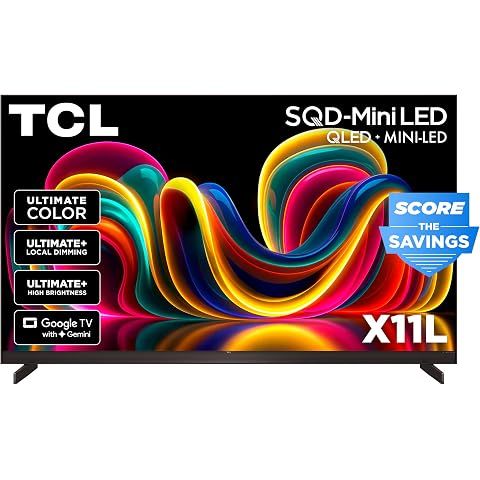
🥇Best Overall: TCL X11L SQD Mini-LED TV

The TCL X11L isn't just another flagship TV. It's a statement that Mini-LED has arrived as a serious challenger to OLED. With 10,000 nits peak brightness and up to 20,736 local dimming zones, it delivers contrast that rivals OLED while absolutely dominating in brightness.
TCL's breakthrough SQD (Super Quantum Dot) technology achieves something no other LED TV has: 100% coverage of the BT.2020 color gamut. Colors aren't just bright, they're accurate across the entire spectrum. The integrated Bang & Olufsen sound system delivers genuine home theater audio without a separate soundbar, and the slim 2cm profile makes it the most elegant large-screen TV available.
Best for: Enthusiasts who want the absolute best picture quality available, especially for HDR content and bright living rooms where OLED struggles.
Limitations: Premium pricing positions it as a flagship investment. The integrated soundbar adds depth that may complicate some mounting scenarios.
For viewers who've been waiting for LED technology to truly compete with OLED, the X11L delivers—and then some.
🥈Runner-up: Samsung QN90F Neo QLED
If the TCL X11L is about pushing boundaries, Samsung's QN90F is about perfecting the fundamentals. It may not win spec sheet battles, but it delivers the most refined daily viewing experience with superior anti-glare technology and processing that competitors struggle to match.
Samsung's Glare Free coating genuinely solves the bright room problem that plagues most TVs. Combined with the Neural Quantum Processor's industry-leading upscaling and Vision AI automatic optimization, you get consistently excellent picture quality without fiddling with settings. The Tizen platform remains the fastest and most intuitive smart TV interface available.
Best for: Anyone who wants excellent picture quality without chasing bleeding-edge specs, especially in challenging lighting conditions.
Limitations: Peak brightness falls short of TCL and Hisense flagships. Some ads in the smart TV interface. Premium pricing across the range.
The QN90F proves that refinement matters as much as raw capability—it's the TV most people will actually enjoy living with.
Best Value Flagship: Hisense U8QG
Hisense has quietly become the brand disrupting the premium TV market, and the U8QG shows why. It delivers 5,000 nits brightness, 165Hz native refresh, and 97.8% DCI-P3 color coverage at prices that make Samsung and Sony look overpriced.
This isn't a compromised budget option dressed up with good specs. The U8QG genuinely performs like a flagship, with HDR that pops, black levels that compete with OLEDs, and gaming features that satisfy competitive players. The VRR support up to 288Hz makes it the best value for PC gamers wanting big-screen performance.
Best for: Anyone who wants flagship performance without flagship prices, especially gamers and HDR enthusiasts with reasonable budgets.
Limitations: Samsung's processing edge shows in some content. The Hisense name may give some buyers pause. Built-in speakers need supplementing.
The U8QG proves you don't need $3,000+ to get a genuinely excellent Mini-LED TV.
Best for Movies: Sony BRAVIA 7 Mini-LED
While other Mini-LED TVs compete on brightness and specs, Sony's BRAVIA 7 focuses on something different: showing content exactly as filmmakers intended. The XR Processor's tone mapping reveals shadow detail and highlight nuance that brighter competitors simply crush.
This philosophical difference matters for serious movie watchers. Netflix Adaptive Calibrated Mode, combined with support for every major HDR format, means you're seeing the director's vision without compromise. The Acoustic Multi-Audio system delivers genuinely impressive sound from the panel itself, reducing soundbar dependency.
Best for: Cinephiles who care about accuracy, content creators needing reference-quality display, and PlayStation 5 owners wanting seamless console integration.
Limitations: Peak brightness can't match TCL or Hisense flagships. Sony pricing runs higher than comparable specs. Limited size options.
The BRAVIA 7 is for viewers who trust the filmmaker's vision over the TV's interpretation.
💸Budget Pick: TCL QM6K QLED TV
The TCL QM6K answers the question: "Can I get real Mini-LED performance without spending $2,000?" The answer is yes, with some reasonable compromises.
At 2,000+ nits, the QM6K outbrights most LCD TVs and delivers HDR that actually looks like HDR. Local dimming isn't as precise as flagship models, but the improvement over standard LED TVs is immediately obvious. Google TV keeps the smart features simple and effective, while 144Hz support means gamers aren't left behind.
Best for: Budget-conscious buyers wanting their first taste of Mini-LED, secondary room TVs, anyone tired of dim LCD performance.
Limitations: Blooming more visible than premium options. Brightness falls short of flagship Mini-LED. Build quality matches the entry-level price.
The QM6K proves Mini-LED isn't just for flagship budgets anymore.
📚More About TCL QM6K QLED TV
Best for Gaming: TCL QM8K

For gamers, the TCL QM8K represents something special: genuine gaming monitor specs in a full-size TV without gaming monitor prices. The combination of 5,000 nits brightness, 144Hz native (288Hz in Game Accelerator mode), and excellent VRR makes it competitive with dedicated gaming displays.
HDMI 2.1 delivers the full PS5 and Xbox Series X experience at 4K/120Hz, while PC gamers can push further with Game Accelerator mode. HDR gaming benefits enormously from the high brightness, making highlights genuinely dazzling rather than just slightly brighter.
Best for: Serious gamers who want the best of both worlds—excellent gaming performance and movie-watching capability in one display.
Limitations: Two HDMI 2.1 ports may frustrate multi-device setups. Processing in game mode is functional rather than refined. Mid-tier pricing may push value seekers toward the U8QG.
The QM8K proves you don't need a dedicated gaming monitor to get competitive performance.
How we researched this
How we chose these: We looked at around 6 products in this category, compared prices across thousands of retailers, and read through hundreds of user reviews. We also tracked how prices have changed over the past few months to get a sense of value.
 Download ShopSavvy App
Compare prices across thousands of stores in real-time, set price alerts, watch for deals by keyword, and much more.
 Install ShopSavvy Browser Extension
Compare and track prices automatically while you shop online at thousands of websites.
🔥 Trending Deals
Footer 1
Get ShopSavvy
ShopSavvy
- Price Comparison
- Compare Prices
- App
- Browser Extension
- Desktop App
- Browser
- QR Code Reader
- ShopSavvy for Business
- AI Agents
- Data API
- Integrations
- Data API Dashboard
- Universal Product Search API
- Bulk Data Licensing
- For Retailers
- Share Your Product Feed
- Data Partners
- Help
- Advertise with Us
- About
- Compare
- Blog
- Press Kit
- Press Inquiries
- Business Inquiries
Subscribe for Updates
Get the latest news, and updates on ShopSavvy. You'll be glad you did!