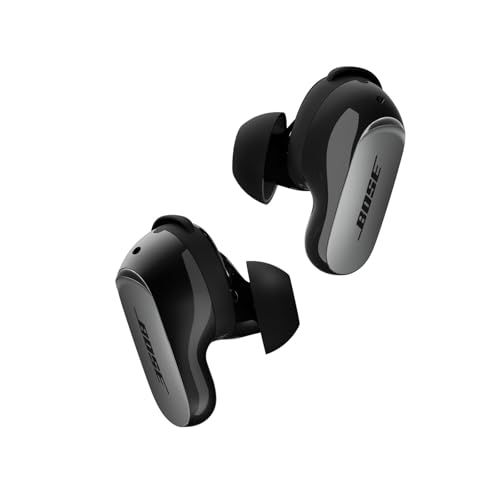
nullJuggling between your phone and laptop all day? Good news—the QuietComfort Ultra Earbuds 2nd Gen can connect to both at the same time. No more fumbling through Bluetooth settings every time you want to switch devices.
Bose calls this feature "multipoint," and it's straightforward once you set it up. Your earbuds maintain active connections to two devices simultaneously—your phone and laptop can both be connected and ready to go.
The best part? Switching happens almost automatically. Pause the music on your phone, hit play on your laptop, and the audio just switches. No disconnecting, no re-pairing, no fuss.
Here's a real scenario: You're listening to music on your phone while working. Your laptop rings with a Teams call. The earbuds switch to your laptop for the meeting, then you can go right back to your phone music when you're done.
Or maybe you're watching a YouTube video on your laptop and your phone rings. The earbuds handle the call, then return you to your video. It's the kind of convenience that sounds minor until you experience how much smoother it makes your day.
Open the Bose Music app and find the Bluetooth Connections settings. There's a toggle for multipoint—flip it on. Then make sure both your devices are paired with the earbuds (you'll need to do the initial pairing for each device separately).
Once that's done, you're set. The earbuds remember both connections and manage them automatically.
You're limited to two devices at a time—not three or four. Incoming calls always take priority, which is usually what you want anyway. And while it works great for most things, some users notice minor audio quality differences when both devices are actively connected.
Quick tip: If you're having trouble with multipoint, make sure your firmware is updated to version 4.0.20 or later through the Bose Music app.
Where this comes from: This answer is based on ShopSavvy's product database, real-time pricing from thousands of retailers, and a look at hundreds of user reviews to give you a well-rounded picture.
Here's our "TLDR" Review
Download ShopSavvy AppCompare prices for anything in real-time, set price alerts, watch for deals by keyword, and much more
Install ShopSavvy Browser ExtensionCompare and track prices automatically while you shop online at thousands of websites.
If you're still curious about the , here are some other answers you might find interesting:
The Bose QuietComfort Ultra Earbuds 2nd Gen and Samsung Galaxy Buds3 Pro are both premium earbuds, but they're built for different priorities. Here's how they actually compare.
Bose costs $299. Samsung lists at $249 but goes on sale more often. If budget matters, Samsung has the edge.
This isn't close. Bose makes some of the best ANC on the market, and these earbuds continue that tradition. If blocking out the world is your main goal, get the Bose.
Samsung's noise cancellation is good, but it's not in the same league.
Bose sounds warmer and more bass-forward. If you like that punchy, full sound (most people do), Bose delivers.
Samsung is more neutral and balanced. Audiophile types might prefer this, but it can sound less exciting to casual listeners.
Both let you tweak EQ in their apps. Samsung supports fancier codecs with Samsung phones.
The Bose earbuds are chunky. They have stability bands that help keep them in place, which is great for exercise, but they're just... big. If you have small ears, they might not fit comfortably.
Samsung went with a more traditional, slimmer design. Most people find them more comfortable for long listening sessions.
Samsung gets about 7 hours with ANC on; Bose gets 6 (or 4 with Immersive Audio). The Samsung case also holds more total charge.
Bose put real effort into SpeechClarity for the 2nd Gen, and it shows. If you're on calls a lot, especially in noisy places, Bose handles it better.
Samsung's IP57 rating beats Bose's IPX4. You could briefly submerge the Samsung earbuds accidentally; Bose are just splash-proof.
Get the Bose if: Noise cancellation and call quality are your priorities.
Get the Samsung if: You want smaller earbuds, longer battery, or have a Samsung phone.
Cinema Mode is Bose's attempt to make movies and TV shows sound like you're in an actual theater—even though you're wearing QuietComfort Ultra Earbuds 2nd Gen.
Regular earbuds give you stereo sound: left and right channels, music positioned between your ears. Cinema Mode processes that stereo signal to simulate sound coming from all around you, like a surround sound setup.
It's different from the regular Immersive Audio modes (Still and Motion), which are designed for music. Cinema Mode is specifically tuned for video content—dialogue, sound effects, and ambient audio.
Great for:
Probably skip it for:
Open the Bose app, find the Immersive Audio section, and select Cinema Mode. You can also set up a shortcut on your earbuds to switch modes without pulling out your phone.
Like all Immersive Audio features, Cinema Mode uses extra battery—about 4 hours instead of 6. Worth it for a movie? Probably. For a quick YouTube video? Maybe leave it off.
This is a hardware feature specific to the 2nd Gen. If you have the original QuietComfort Ultra Earbuds, no firmware update will add this—you'd need the newer model.
The QuietComfort Ultra Earbuds 2nd Gen have touch controls on both sides. Here's what you can actually do with them.
Tap once — Play/pause. Also answers or ends calls.
Tap twice — Skip to the next song.
Tap three times — Go back to the previous song.
Swipe up — Volume up.
Swipe down — Volume down.
Press and hold — Configurable, but by default cycles through listening modes (Quiet, Aware, Immersion).
A few tips from experience:
The Bose app lets you change what press-and-hold does for each earbud. You could set:
Options include voice assistant, listening modes, Immersive Audio modes, play/pause, and skip track.
Accidentally triggering controls all the time? Disable touch controls completely through the app (Settings → Product Control → Toggle off).
You'll lose the convenience, but no more random pauses when adjusting your earbuds.
Same basic controls work:
Short answer: No. But the QuietComfort Ultra Earbuds 2nd Gen handle sweat and rain just fine.
These earbuds have an IPX4 rating. In plain English: they can handle sweat, light rain, and splashes. They cannot handle being submerged in water.
No swimming, no showering with them in, and don't drop them in the toilet. But for workouts? You're good.
✅ Gym workouts (even sweaty ones) ✅ Running in light rain ✅ Spin class ✅ Walking in humid weather ✅ Getting caught in a drizzle
❌ Swimming ❌ Showering ❌ Getting caught in heavy rain ❌ Beach activities (saltwater is especially bad) ❌ Hot tubs
This trips people up—the earbuds have water resistance, but the case has zero protection. Keep that case dry.
Take care of them:
The AirPods Pro 3 and Samsung Galaxy Buds3 Pro both have IP57 ratings, which is better water protection. If you need to work out in the rain regularly, those might be worth considering.
For most people doing normal gym workouts? IPX4 is plenty.
No product is perfect. Here are the issues people actually run into with the QuietComfort Ultra Earbuds 2nd Gen—and what you can do about them.
Some people hear a faint hiss when noise cancellation is on but no music is playing. This happens with pretty much all ANC earbuds—it's just how the technology works. There's no fix because it's not really a "bug."
Those wing things (stability bands) sometimes spin around and get wedged weird in the case. Annoying, but not a big deal. Just make sure the notches line up when you put them in.
If you have smaller ears, these might just not fit well. They're chunky earbuds. Even the smallest tips and bands won't work for everyone.
Watching a movie in bed and they just disconnect? Some users report this. The earbuds think you've stopped using them. Moving your head slightly every now and then seems to prevent it.
Usually means dust or debris got in the microphone holes. Clean them gently with a soft brush. More common if you use them during workouts.
Sometimes they just won't connect right. Try the usual: remove from Bluetooth list, factory reset, update firmware.
Battery life of 5.5 hours instead of 6? Normal. That's how advertised specs work.
One earbud not charging at all? Problem. Clean the contacts, try a reset, contact Bose if it persists.
Most issues have simple fixes. If something keeps happening after the basics (cleaning, resetting, updating), contact Bose support. Your serial number is in the app under Settings → Support.
Opening the box for the first time? Here's everything you'll find inside your QuietComfort Ultra Earbuds 2nd Gen.
The earbuds — Left and right, already set up with medium ear tips and size 2 stability bands (the wings that help them stay in your ears).
The charging case — Works with wireless chargers and USB-C. Has an LED on the front to show battery status.
Bose knows everyone's ears are different, so they include options:
Ear tips — Three sizes (small, medium, large). Mediums come pre-installed. These silicone tips include rubberized guards (new in the 2nd Gen) that help keep earwax from building up on the speakers.
Stability bands — Three sizes (1, 2, 3). Size 2 is pre-installed. These concha fins hook into your ear's curve for a secure fit.
You get a short USB-A to USB-C cable—about 12 inches. Enough to reach from a laptop USB port.
What you don't get: A wall adapter. Bose assumes you have one already (you probably do). Also no USB-C to USB-C cable, so if your laptop only has USB-C, you'll need your own.
This matters more than you might think. The wrong fit means weaker bass and less effective noise cancellation.
Start with pre-installed sizes. If the seal feels loose or bass sounds thin, try larger tips. If earbuds feel unstable during exercise, adjust stability bands. Many people find mixing sizes works best—like large tips with medium bands.
Planning your listening time with the QuietComfort Ultra Earbuds 2nd Gen? Here's the full picture on charging and battery life.
Your earbuds get about 6 hours of playtime (4 with Immersive Audio). The case holds another 18 hours worth of charges, giving you roughly 24 hours total before everything needs a plug.
Earbuds in the case: About an hour from dead to full. But here's the useful bit—just 20 minutes gives you 2 hours of listening. Perfect for when you're running out the door.
The case itself:
Wireless is convenient, but wired is faster when you need it.
The LED on the case tells you what's happening:
When you open the case with earbuds inside:
A few practical tips:
Bose says 6 hours, and testing usually shows around 5.5 hours in practice. That's normal—volume level and features used affect it. Most people find it's plenty for a workday or long flight.
Most earbuds give you a simple choice: noise cancellation on, or off (transparency mode). ActiveSense on the QuietComfort Ultra Earbuds 2nd Gen makes that choice smarter.
Think of it as transparency mode with a brain. Instead of just letting all external sound through, ActiveSense listens to your environment and makes decisions about what you probably want to hear.
Sustained background noise like train rumble or air conditioning? It reduces that. Sudden important sounds like someone calling your name or a car horn? Those come through clearly.
Your earbuds have three main listening modes:
Quiet Mode — Full noise cancellation. The world goes quiet. Best for focus.
Aware Mode (with ActiveSense) — This is where the smart stuff happens. You hear your surroundings, but the earbuds smooth out the experience.
Immersion Mode — Full ANC plus Bose's spatial audio effect. Maximum immersion.
Walking in the city: Hear traffic and people around you without every car engine at full volume.
On public transit: Hear announcements clearly while constant train rumble gets dialed down.
At the office: Notice when someone's trying to get your attention without constant HVAC drone.
At home: Hear the doorbell or kids calling without every household sound competing with your music.
Press and hold the touch-sensitive area on either earbud to cycle through modes. Or use the Bose app for more control. You can set up shortcuts so left and right earbuds do different things.
The biggest complaint about the original QuietComfort Ultra Earbuds? Call quality. People on the other end couldn't always hear you clearly, especially in noisy places. Bose fixed that with SpeechClarity on the 2nd Gen.
SpeechClarity is a smart filter for your voice. When you're on a call, the earbuds use AI to figure out what's your voice and what's background noise—then suppress the "everything else."
The tech behind it is impressive: eight microphones working together, plus bone conduction sensors that detect the vibrations of your actual speech. That combination helps the system know with confidence what's you talking versus what's a coffee shop or traffic.
From user reports? Yes, significantly. People who upgraded specifically for better call quality say the difference is noticeable. Callers hear less background noise, voices come through clearer, and even wind is handled better (though strong wind still causes issues—that's just physics).
If you work from home and take video calls, or you're often on the phone in public spaces, this is a meaningful improvement.
No earbuds handle extreme wind perfectly. If it's really blowing, you're going to have issues regardless of how good the tech is. Also, Bluetooth has bandwidth limitations that affect voice quality on any wireless device.
If call quality was the one thing holding you back from the original model, SpeechClarity specifically addresses that complaint. Users who upgraded for this feature generally report it was worth it.
Good news for Android users—the QuietComfort Ultra Earbuds 2nd Gen work great with your phone. And honestly, they might work better for you than AirPods would.
Unlike some premium earbuds that feel like they were made for iPhones first, these Bose earbuds treat Android as a first-class citizen. All the features work:
You're not missing out on anything.
The Bose Music app on Android does everything the iOS version does:
It's not a watered-down version. It's the real deal.
Here's something interesting: if you have a newer Android phone with a Qualcomm Snapdragon chip (8 Gen 3 or newer), you get access to aptX Adaptive. That's a high-quality audio codec that iPhones can't use.
Plus, Google Fast Pair works—just open the case near your phone and it prompts you to connect.
AirPods are great... if you have an iPhone. On Android, you lose features like spatial audio and automatic ear detection. These Bose earbuds don't have that problem. Everything works everywhere.
Some users have reported occasional quirks with the Bose app on certain Samsung phones. Bose keeps updating the app to fix these issues. The earbuds themselves work fine—it's just some app features that can be inconsistent on specific models.
Loading trending deals...
Get the latest news, and updates on ShopSavvy. You'll be glad you did!